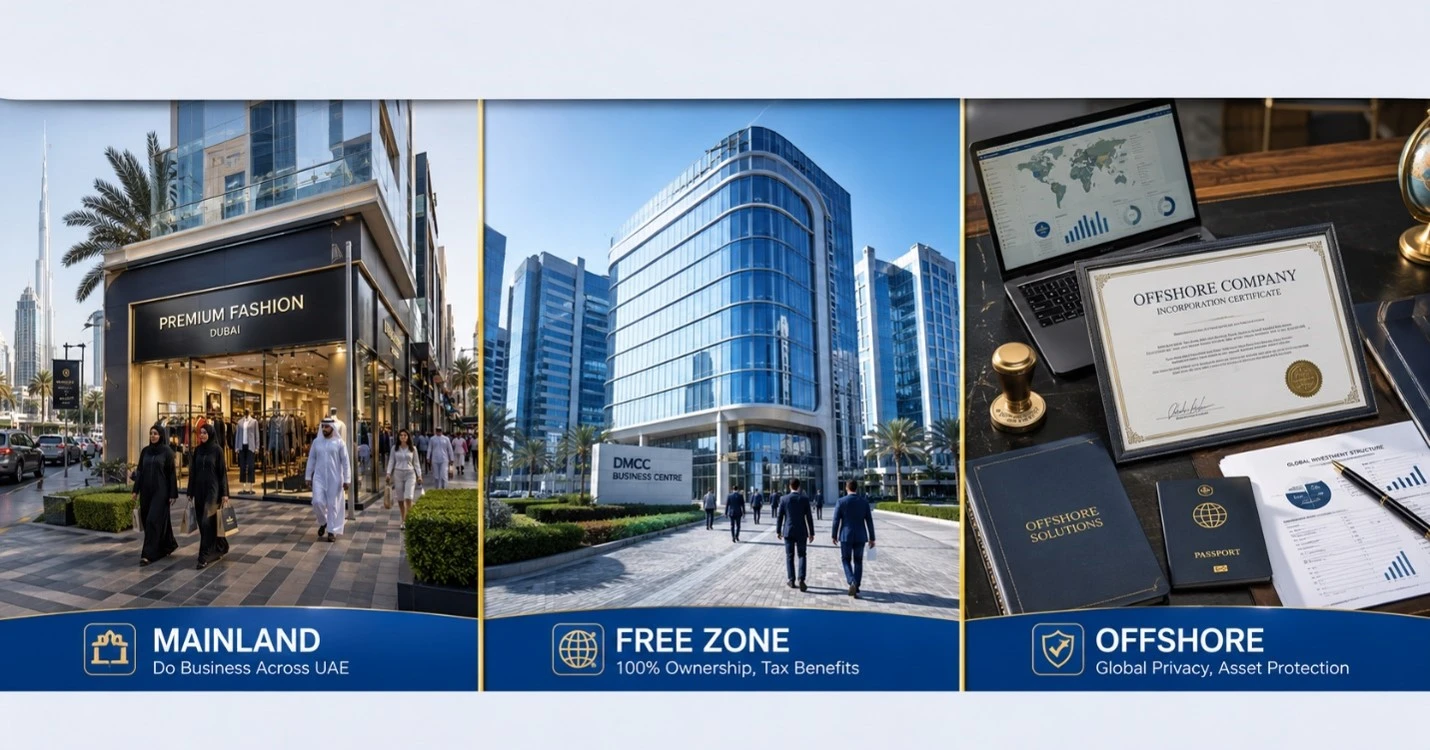
Mainland vs Free Zone vs Offshore: Which Is Best for Starting a Business in the UAE?
If you've started researching UAE business setup, you've probably noticed the same three words keep coming up: mainland, free zone, offshore.
They sound similar, and consultants often use them loosely, but they're legally distinct structures with very different implications for tax, visas, and who you're allowed to do business with. Pick the wrong one, and you could end up with a company that can't sell to the customers you actually want, or a license with no path to a residency visa.
This guide breaks down exactly what each structure does, what it costs in 2026, and how to match it to your actual business model — not just the cheapest sticker price.
Background: Three Structures, Three Different Purposes
Every company registered in the UAE falls into one of three legal categories, each governed by a different authority and rulebook.
- Mainland companies are licensed by each emirate's Department of Economy and Tourism (DET in Dubai, formerly DED) under UAE Commercial Companies Law. They can trade anywhere in the UAE and internationally.
- Free zone companies are licensed by one of the UAE's 45+ free zone authorities (DMCC, IFZA, RAKEZ, DIFC, ADGM, and others), each with its own rules. They get streamlined registration and, for qualifying activities, a 0% corporate tax rate — but generally can't sell directly to UAE mainland customers.
- Offshore companies are registered through one of the UAE's two recognised offshore registries — RAK ICC (Ras Al Khaimah) or JAFZA Offshore (Dubai) — purely as non-operational vehicles for holding assets, IP, or international business. They cannot rent office space, hire staff in the UAE, or sponsor visas.
Clarifying the Offshore Misconception
The confusion usually comes from people using "offshore" loosely to describe any non-mainland setup. In UAE terms, offshore has a specific, narrow meaning: it's a company that is legally barred from doing business inside the UAE at all.
Head-to-Head Comparison
| Feature | Mainland | Free Zone | Offshore |
|---|---|---|---|
| Foreign ownership | 100% (most activities) | 100% | 100% |
| UAE market access | Full access, anywhere | Zone + international; mainland sales need a distributor | None — cannot trade inside the UAE |
| Physical office required | Yes | Optional (flexi-desk available) | No |
| Residency visa eligibility | Yes | Yes | No (standard structures) |
| Corporate tax on qualifying income | 9% above AED 375,000 profit | 0% if QFZP conditions are met | Exempt (no UAE-sourced income) |
| Typical Year 1 cost | AED 30,000–45,000 | AED 18,000–35,000 | AED 7,200–18,900 |
| Setup timeline | 3–6 weeks | 3–7 working days | 3–7 working days |
| Property ownership in Dubai | Yes | Depends on zone | Yes (RAK ICC and JAFZA both now permitted) |
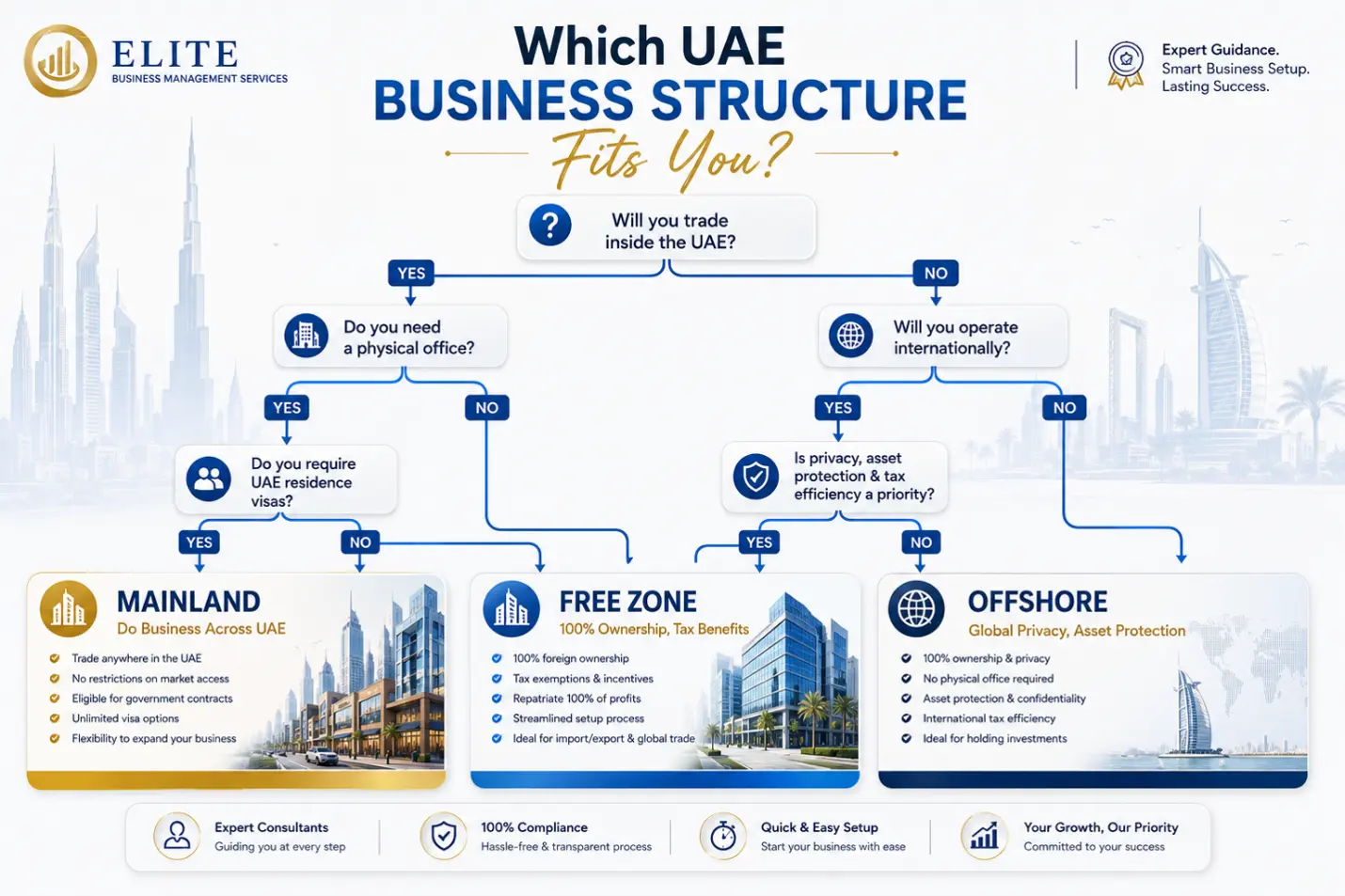
Step-by-Step: How to Choose the Right Structure
Identify Your Customer Base
If you're selling to UAE-based businesses or consumers, mainland is usually non-negotiable. If your clients are international, a free zone gets you most of the same benefits at a lower cost.
Determine UAE Residency Needs
Offshore companies cannot sponsor residency visas. If you plan to relocate, hire staff locally, or need an Emirates ID, rule offshore out immediately — mainland or free zone are your only options.
Model Your Tax Exposure
Estimate your expected profit and check whether your income would qualify as "Qualifying Income" under free zone tax rules, or whether it's realistically mainland-sourced and taxed at 9% regardless of jurisdiction.
Weigh Speed vs. Flexibility
Free zones and offshore structures both move faster than mainland licensing, largely because mainland requires Ejari-registered office space before the license is issued.
Confirm Structure with an Advisor
Some businesses actually need two structures working together — for example, a RAK ICC or JAFZA offshore holding company sitting above an operating free zone or mainland entity. This is common for asset protection, succession planning, and multi-jurisdiction groups.
Benefits at a Glance
Mainland
- Unlimited UAE market access, including government contracts.
- No cap on visa allocation (scales with office size).
- Full flexibility on physical retail, F&B, and public-facing operations.
Free Zone
- Fastest and cheapest route to a visa-eligible company.
- Potential 0% corporate tax for Qualifying Free Zone Persons.
- Sector-specific ecosystems (DIFC, DMCC, Dubai Silicon Oasis).
Offshore
- Lowest cost structure of the three.
- Strong privacy and asset-protection features.
- Access to UAE's 140+ double taxation treaty network.
- No UAE corporate tax exposure (no UAE-sourced income).
Eligibility & Requirements
All three structures are open to most nationalities, but the entry requirements differ:
None of the three structures currently require a minimum paid-in share capital for most standard activities, though mainland LLCs typically declare AED 50,000 in share capital on paper.
Costs & Timeline Snapshot (2026)
| Structure | Setup Cost (Year 1) | Annual Renewal | Time to Incorporate |
|---|---|---|---|
| Mainland | AED 30,000–45,000 | AED 8,000–15,000 | 3–6 weeks |
| Free Zone | AED 18,000–35,000 | AED 10,000–20,000 | 3–7 working days |
| RAK ICC Offshore | AED 7,200–13,600 | AED 4,500–7,000 | 3–5 working days |
| JAFZA Offshore | AED 10,100–18,900 | AED 6,000–9,500 | 5–7 working days |
The Account Opening Wildcard: Expect 3–8 weeks for mainland and free zone corporate bank accounts, and potentially longer for offshore entities due to rigorous compliance and due diligence checks on non-operational structures.
Latest UAE Updates for 2026
Offshore Property Ownership
RAK ICC offshore companies can now own freehold property in Dubai's designated zones — a capability previously exclusive to JAFZA — narrowing one of the biggest historical differences between the two offshore registries.
ESR Reporting Abolished
Economic Substance Regulation (ESR) reporting has been cancelled for financial years ending after 31 December 2022, removing a compliance burden that previously applied to offshore holding, IP, and finance-related structures.
QFZP Scrutiny
QFZP compliance checks on free zone companies are highly document-driven in 2026, with the FTA scrutinising genuine substance and the de minimis threshold (the lower of AED 5 million or 5% of revenue from non-qualifying mainland income) more closely than in prior years.
RAK ICC Hybrid Structures
RAK ICC's "Premium Product" now allows an offshore IBC to own shares in a RAKEZ free zone company, creating a hybrid structure where the offshore entity indirectly gains visa eligibility through its free zone subsidiary.

Conclusion: Match the Structure to the Strategy, Not the Price Tag
Mainland, free zone, and offshore aren't competing options — they're tools built for different jobs. The right call depends on where your customers are, whether you need to live in the UAE, and how your tax exposure looks as you scale, not just which license costs less upfront.
Map Out Your UAE Business Structure Flawlessly
Elite Business Management Services helps founders map out exactly which structure — or combination of structures — fits their business, then handles the licensing, tax registration, and banking process from start to finish. If you're ready to set up in the UAE the right way, get in touch with us today.









Leave a comment